


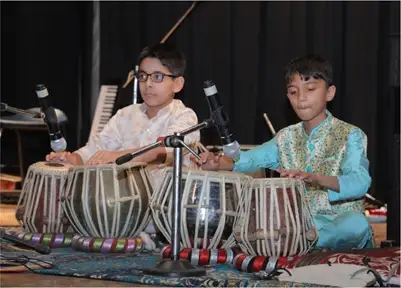
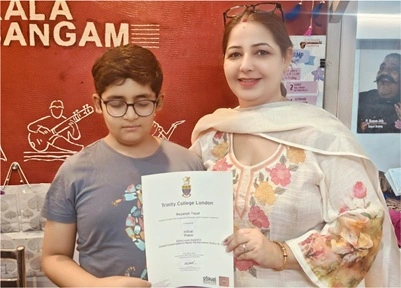
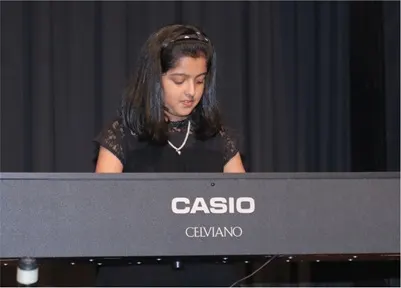
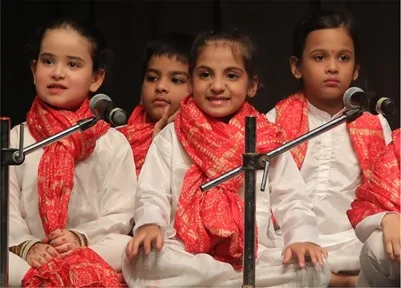
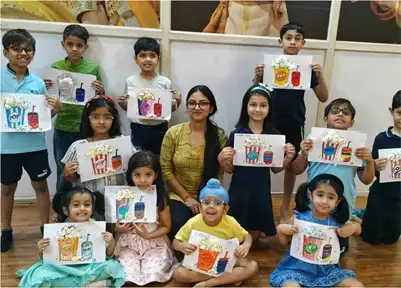
Learning music from childhood develops cognitive abilities, emotional intelligence, fine motor skills, confidence and discipline. Scientific research consistently shows that musically trained children outperform peers in academics, social skills and long-term wellbeing. At Swar Kala Sangam Gurgaon, children begin this journey from age 3.
Every parent who has enrolled their child in music classes has acted on an intuition that something important is happening. That intuition is correct — and science confirms it in depth. The benefits of music education for children extend far beyond the ability to play a song. They reach into the fundamental architecture of brain development, emotional intelligence and character formation.
What Neuroscience Says About Music and Children's Brains
The most comprehensive research on music and child development comes from neuroscience. Studies from Harvard Medical School, Stanford University and the Royal Conservatory of Music have consistently demonstrated that children who receive regular music training show measurable changes in brain structure and function:
- Larger corpus callosum — The bridge between the brain's hemispheres is physically larger in musicians, improving communication between logical and creative thinking
- Enhanced auditory cortex — Music training develops a more sophisticated ability to detect subtle differences in sound — a skill that directly improves reading and language learning
- Greater executive function — Working memory, attention control and cognitive flexibility all improve with music training
- Stronger mathematical reasoning — The pattern recognition, fractions and spatial logic embedded in music notation and rhythm directly strengthen mathematical thinking
The 10 Key Benefits of Music Education for Children
- 1. Improved academic performance — Particularly in mathematics and reading
- 2. Better memory — Memorising compositions strengthens working and long-term memory
- 3. Enhanced focus and concentration — Practising music develops sustained attention
- 4. Fine motor skill development — Particularly with Piano, Guitar and Tabla
- 5. Emotional intelligence — Expressing emotion through music builds empathy and self-awareness
- 6. Confidence and stage presence — Performance experience builds real-world confidence
- 7. Discipline and goal-setting — Learning a piece systematically teaches perseverance
- 8. Cultural connection — Particularly valuable for classical Indian arts (Hindustani Vocal, Kathak)
- 9. Stress relief and emotional regulation — Music provides a healthy emotional outlet
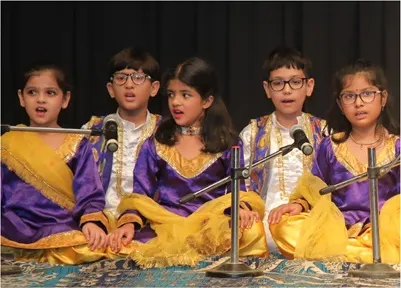
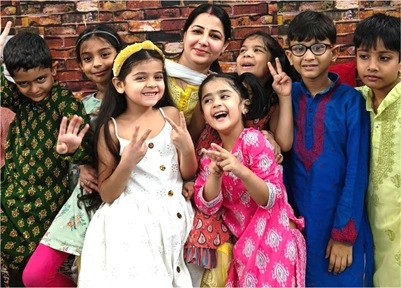
- 10. Social skills — The academy community, group performances and ensemble playing develop social intelligence
The Kathak Advantage — Body and Mind Together
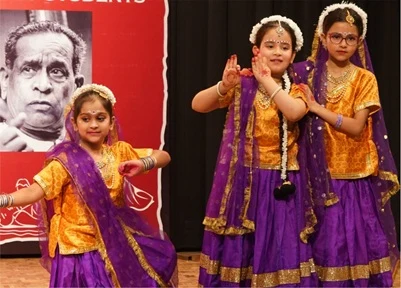
For children learning Kathak at Swar Kala Sangam, the benefits extend into physical development in a way that most other arts do not. Taatkar (footwork) builds leg strength, balance and cardiovascular fitness. Chakkar (spins) develop the vestibular system — improving overall spatial orientation and coordination. Abhinaya (expression) teaches children to read and project emotional states — a social skill with lifelong value.
Music and Academic Performance — The Numbers
| Study | Finding |
|---|---|
| University of Toronto (2004) | Children with music lessons showed greater improvements in IQ scores than control groups |
| Journal of Neuroscience (2009) | Musical training accelerates brain development in language areas |
| Northwestern University (2012) | Music training improves poverty-related gaps in language skills |
| Royal Conservatory of Music (2014) | Musically trained students scored 20% higher in English and 14% higher in Math |
Starting Music at Swar Kala Sangam, Gurgaon
Children in Gurgaon can begin their musical journey at Swar Kala Sangam from age 3. The academy's three centres — Sector 49 (South City, Sohna Road), Sector 27 (Golf Course Road, DLF) and Sector 83 (Dwarka Expressway, New Gurgaon) — offer age-appropriate programmes for every stage of childhood development.