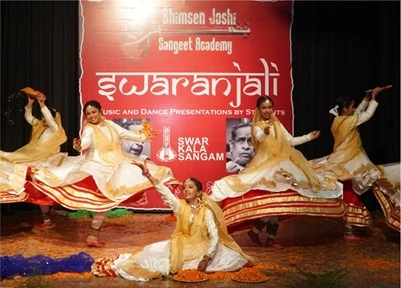
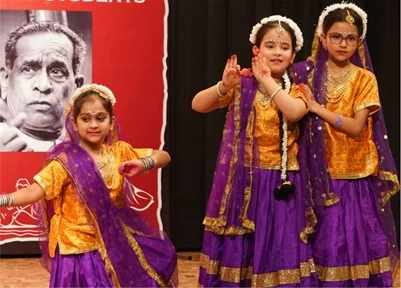
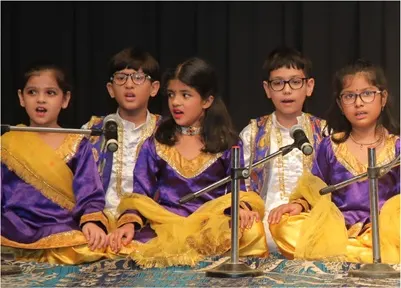
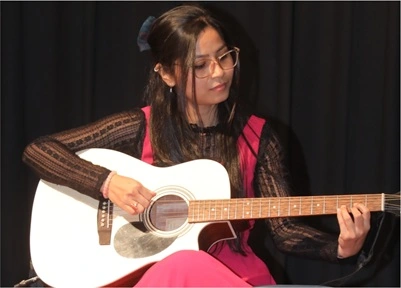
Live lessons are better for most learners because a teacher hears and sees you and corrects mistakes in real time — essential for pitch (sur), rhythm (laya) and dance posture, which are hard to judge in yourself. Recorded courses and YouTube are cheaper and useful for reference and revision, but they can't tell you what you're doing wrong. The best approach is live classes, with recordings as a supplement.
There has never been more free music content online. Thousands of YouTube videos and apps promise to teach you to sing, play tabla or dance Kathak. So why do so many learners still choose live online music lessons with a teacher? The answer comes down to one word: feedback.
The key difference: feedback
A recorded lesson is one-way. You watch, copy, and decide for yourself whether you got it right. A live lesson is a conversation: the teacher demonstrates, you respond, and the teacher corrects exactly what you did — a note slightly flat, a stroke uneven, a hand held too low.
In Indian classical music and dance, this loop is how the art has always been passed on. The Guru–Shishya tradition is built on the teacher listening closely and refining the smallest details.
Why live teaching matters for classical music
Pitch (sur) is hard to hear in yourself
Most beginners can't reliably tell when they are slightly off-key. A teacher hears it instantly and shows you how each note of a raga should be approached, including slides (meend) and ornaments.
Rhythm (laya) needs an outside ear
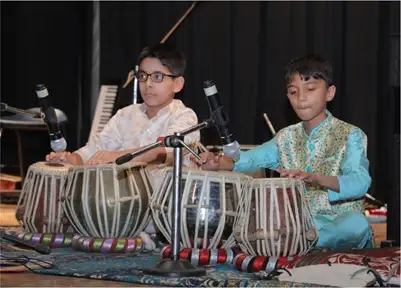
A tabla kaida or a tihai can feel right while drifting in tempo or losing clarity. A teacher catches it before it becomes a habit.
Dance depends on posture you can't see
In Kathak and Bharatnatyam, alignment, footwork and hand positions must be watched from outside. More in Can you learn Kathak online?
Bad habits form quickly
Repeating a small mistake for weeks makes it much harder to undo — and can even cause strain in the voice or wrists.
Live vs recorded: comparison
| Feature | Live online lessons | Recorded courses / YouTube |
|---|---|---|
| Corrects your mistakes | ✔ In real time | ✘ You self-assess |
| Pace | Adapted to you | Fixed by the video |
| Personal syllabus | ✔ | ✘ Same for everyone |
| Ask questions | ✔ Immediately | ✘ Rarely |
| Accountability | A weekly class and a teacher expecting progress | Depends entirely on you |
| Exam preparation | ✔ Guided | Limited |
| Cost | Higher | Low or free |
| Flexibility | Scheduled class times | Any time |
Try a Live Class — Free
Meet your teacher, discuss your goals and get a recommendation on the right class format. No payment needed.
When recordings are useful
- Revision: recording your own live class (with your teacher's permission) gives you an exact reference for the week.
- Listening: hearing great artists trains your ear for how ragas and compositions should sound.
- Self-review: recording your practice and listening back reveals things you miss while playing.
- Theory: videos can explain concepts such as thaats, taals or notation well.
Which should you choose?
If you want to build real skill in singing, an instrument or dance, choose live lessons and use recordings to support your practice. If you only want casual exposure or have a very tight budget, recorded content is a reasonable first taste — but expect slower progress and some habits to unlearn later.
Live classes at Swar Kala Sangam
Every regular class at Swar Kala Sangam is 100% live on Zoom or Google Meet, taught by experienced teachers in India, in 1:1, 1:2 or 1:4 formats, with practice guidance after every class. Explore our online classes.
Start Your Musical Journey Today
Live online classes from India and in-person classes in Gurgaon. Your first class is free — no payment, no commitment.
Written by the faculty team at Swar Kala Sangam Sangeet Academy — the music academy of Pt. Bhimsen Joshi Sangeet Academy, founded in 1978. Information is general guidance and correct as of 22 November 2026; examination boards and fees can change, so always check current details.