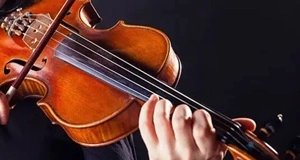
The violin has four strings tuned G–D–A–E and is played with a bow. Its range and singing tone make it the lead voice of the Western orchestra and string quartet, and a favourite first instrument for children worldwide.
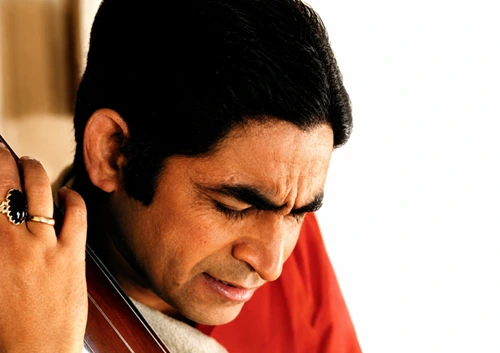
The violin also became part of Indian classical music. In Carnatic music it was adopted in the early 19th century and is now the standard melodic accompaniment; in Hindustani music, artists such as Pt. V. G. Jog and Dr. N. Rajam developed a singing, voice-like style known as gayaki ang.
At Swar Kala Sangam, online violin students choose a Western pathway (technique, notation and graded repertoire on the Trinity College London syllabus) or an Indian pathway (Sargam, Alankaars and Raga-based melodies) — or combine both.
गज़ · Bow
Bow Control
Straight bowing, even pressure and smooth bow changes — the source of a clear, beautiful tone.
सुर · Intonation
Playing in Tune
The violin has no frets, so every note is placed by ear. Intonation is trained from the very first lesson.
मींड · Meend
Glides & Ornaments
Smooth slides between notes that give Indian violin its vocal quality — learnt in the Indian pathway.
स्वरलिपि · Notation
Reading Music
Staff notation and sight-reading for the Western pathway; Sargam notation for Indian repertoire.